
Luxury Hotels
Dichotomy of Service: More Staff or More AI?

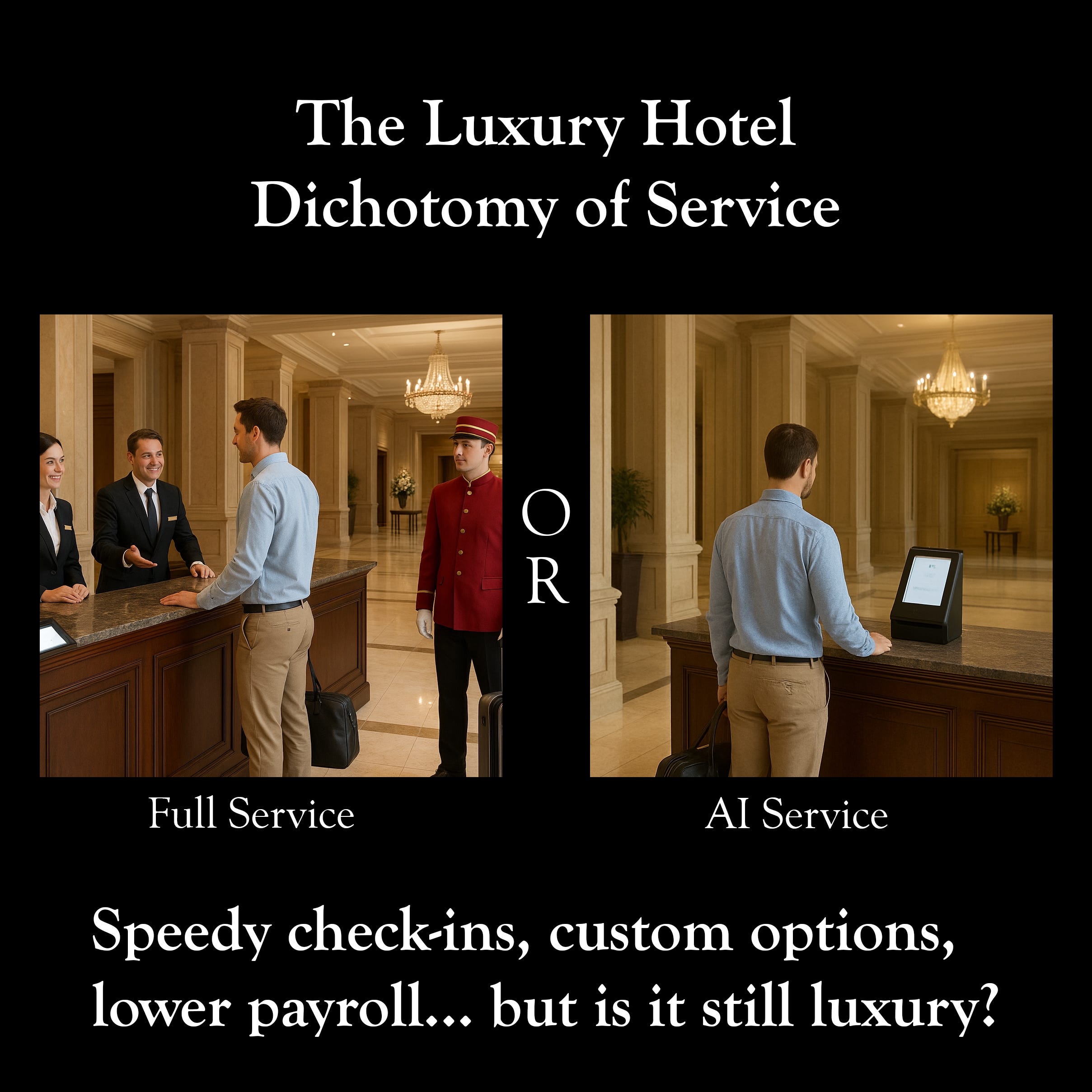
How is it possible to operate a luxury hotel (or a portfolio full of them) in 2025, with discerning clients that expect personalized service with a human touch, while still implementing as much AI and technology as possible to leverage automation and improve profit margins?
Regardless of where you fall in the “more staff vs more AI” debate, go show some love and subscribe to The Check-In podcast. Learn about the sordid history and scandals of the world’s most famous - and infamous - hotels.
Establishing a set of Key Performance Indicators to measure performance is the first step in considering profit margins. The KPIs I recommend will focus on a balanced set of KPIs across financial, operational, guest experience, and market positioning metrics. Key ones include Occupancy Rate, Average Daily Rate (ADR), Revenue Per Available Room (RevPAR), Gross Operating Profit per Available Room (GOPPAR), Net Operating Income (NOI), Customer Satisfaction Score (e.g., NPS), Employee Turnover Rate, and Market Share Index. These provide insights into revenue generation, cost efficiency, guest loyalty, and competitive standing, enabling data-driven decisions to maximize returns.
Next, what are the latest and greatest technologies that should be implemented to handle back office operations, the front of house experience, and other things that can be deployed to enhance the guest experience? The latest technologies emphasize AI integration, IoT for personalization, and cloud-based automation to streamline operations while elevating guest experiences. Key implementations include AI-driven revenue management for back office efficiency, contactless check-in systems for front of house, and IoT smart rooms for guest enhancements. I would be remiss if I didn’t mention that there are options to custom build your own tools and save thousands on licensing costs.
Finally, we will explore ways that a hotel can operate as a premium brand, where clients demand personalization and a human touch, while still implementing as much AI and technology as possible to leverage automation and improve profit margins.
Key Performance Indicators
Financial KPIs: These focus on revenue, profitability, and return on investment, which are paramount for a real estate firm evaluating the portfolio’s contribution to overall asset performance.
Occupancy Rate
Definition: The percentage of available rooms that are occupied over a given period.
Calculation: (Number of rooms sold / Total available rooms) × 100.
Importance: In luxury hotels, high occupancy signals strong demand and effective marketing, but over-reliance can lead to wear and tear on high-end amenities. For investors, it’s a leading indicator of revenue potential and helps assess market conditions or seasonal trends. Low occupancy might prompt rate reductions or targeted promotions.
Benchmark: 70-85% for luxury properties; aim higher in peak seasons.
Average Daily Rate (ADR)
Definition: The average revenue earned per occupied room, excluding complimentary rooms.
Calculation: Total room revenue / Number of rooms sold.
Importance: Luxury hotels thrive on premium pricing, so ADR reflects brand strength and pricing power. It’s crucial for investors to track this against inflation and competitor rates to ensure the portfolio maintains its high-end positioning without alienating guests. Fluctuations can indicate opportunities for dynamic pricing or upselling suites.
Benchmark: $300-$800+ depending on location (e.g., higher in urban centers like New York or Paris).
Revenue Per Available Room (RevPAR)
Definition: A combined metric of occupancy and ADR, showing overall room revenue efficiency.
Calculation: ADR × Occupancy Rate, or (Total room revenue / Total available rooms).
Importance: RevPAR is a core indicator for portfolio health, as it balances volume (occupancy) with value (ADR). For real estate investors, it’s key for valuing assets during acquisitions or sales, and it helps identify underperforming properties needing repositioning. In luxury segments, focus on RevPAR growth to justify capex investments like renovations.
Benchmark: $200-$600+; track year-over-year growth of 5-10%.
Gross Operating Profit Per Available Room (GOPPAR)
Definition: Profit from operations per available room, after deducting variable and fixed operating expenses but before taxes and interest.
Calculation: (Total revenue - Operating expenses) / Total available rooms.
Importance: This goes beyond revenue to measure operational efficiency, critical for luxury hotels with high costs in staffing and amenities. Investors use it to evaluate cost controls and profitability, ensuring the portfolio generates sufficient cash flow for debt service or dividends. It’s especially useful for comparing properties within the portfolio.
Benchmark: $100-$300+; aim for margins of 30-40% of revenue.
Net Operating Income (NOI)
Definition: The property’s income after all operating expenses, excluding debt service, taxes, and capital expenditures.
Calculation: Total revenue - Operating expenses (including management fees, utilities, etc.).
Importance: As a real estate metric, NOI is essential for calculating cap rates and asset valuations in your portfolio. For luxury hotels, it highlights the impact of high-margin ancillary revenues (e.g., events, wellness services) and helps prioritize investments in properties with rising NOI trends.
Benchmark: Varies by property size; target 10-15% annual growth.
Operational and Guest Experience KPIs: These ensure the hotels run smoothly and maintain the luxury appeal that drives repeat business and premium pricing.
Customer Satisfaction Score (aka Net Promoter Score - NPS)
Definition: A measure of guest loyalty, based on how likely they are to recommend the hotel.
Calculation: Percentage of promoters (scores 9-10) minus detractors (0-6) on a 0-10 scale.
Importance: Luxury hotels rely on exceptional experiences for differentiation. High NPS correlates with repeat visits, positive reviews, and word-of-mouth, which boost occupancy and ADR. For investors, poor scores can signal underlying issues like service gaps, potentially eroding long-term value. Track via post-stay surveys or platforms like TripAdvisor.
Benchmark: 70+ for luxury brands; anything below 50 warrants immediate action.
Employee Turnover Rate
Definition: The rate at which staff leave and are replaced.
Calculation: (Number of employees who left / Average number of employees) × 100, over a period.
Importance: Luxury service demands skilled, consistent staff; high turnover increases training costs and disrupts guest experiences, impacting satisfaction and efficiency. Investors should monitor this to avoid operational risks that could lower NOI. It’s also a proxy for company culture post-acquisition.
Benchmark: Under 30% annually; luxury sector averages 40-50%, so aim lower.
Market and Competitive KPIs: These provide external context to gauge the portfolio’s positioning.
Market Share Index (or Competitive RevPAR Index)
Definition: Your hotel’s RevPAR as a percentage of the competitive set’s average RevPAR.
Calculation: (Your RevPAR / Competitive set RevPAR) × 100.
Importance: In a portfolio context, this reveals how well your luxury hotels perform against peers (e.g., other 5-star properties in the same market). A declining index might indicate lost competitiveness, prompting marketing or amenity upgrades. For real estate firms, it’s vital for strategic decisions like expansions or divestitures.
Benchmark: 100% or higher; strive for 110-120% in premium segments.
To implement these effectively, integrate them into a dashboard (e.g., using tools like Tableau or hotel-specific software like Opera PMS). Set alerts for deviations, conduct regular audits, and align with broader investment goals like ROI or EBITDA multiples. If the portfolio spans multiple regions, segment KPIs by location to account for local variations. This focused tracking will help optimize performance and enhance the portfolio’s value.
Technology
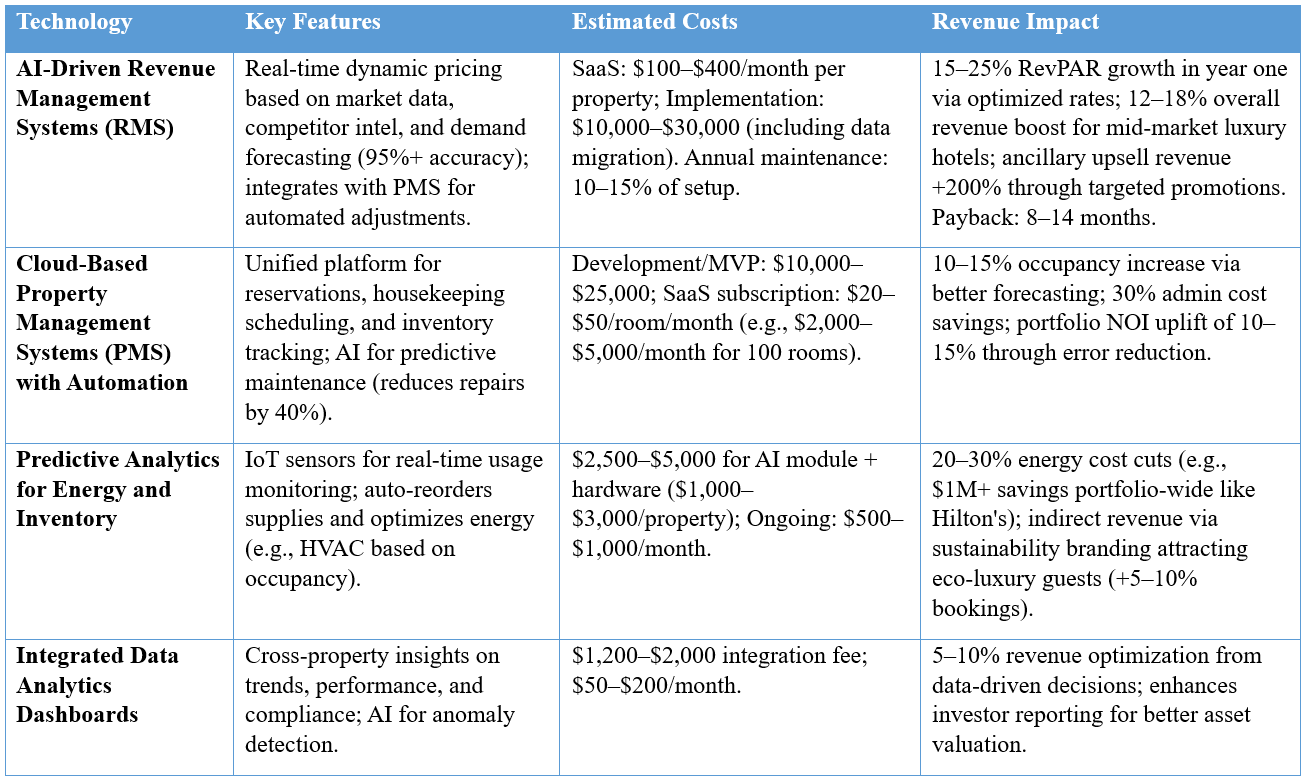
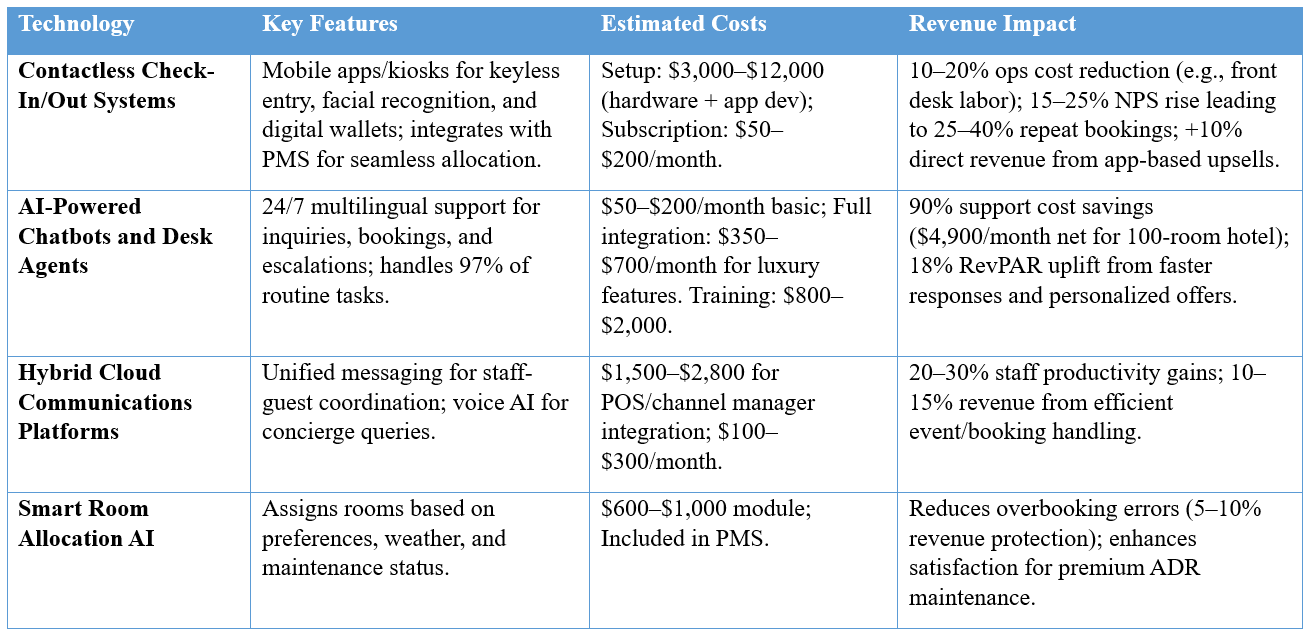
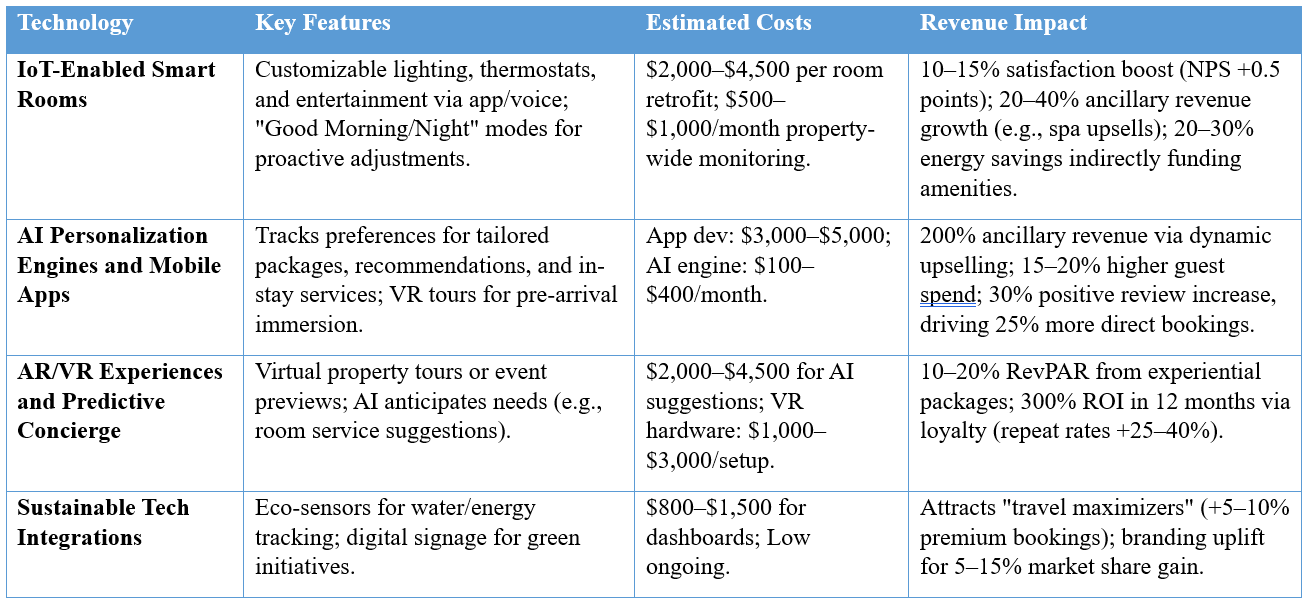
In 2025, luxury hotel technology shifts from siloed tools to integrated ecosystems powered by AI, IoT, and cloud platforms, addressing labor shortages (affecting 65% of properties), rising costs, and demands for hyper-personalized experiences. These innovations not only optimize back office operations but also transform front of house interactions and guest journeys, directly boosting KPIs like RevPAR and NOI. Implementation should start with pilot programs in one property, scaling via vendor partnerships (e.g., Mews, Guestara) for seamless PMS integration. Below, I break it down by category, highlighting top technologies, their features, estimated costs (based on mid-sized luxury properties; scale for portfolios), and revenue impacts.
Back Office Operations
Back office tech focuses on automation and predictive analytics to cut administrative burdens by 20–30%, enabling real estate investors to monitor portfolio-wide efficiency via centralized dashboards. Prioritize cloud-native solutions for scalability across multiple hotels.
Front of House Experience
Front of house tech streamlines staff workflows, reducing wait times by 60% and freeing personnel for high-touch luxury service. Contactless options are now table stakes, boosting NPS by 15–25%.
Guest Experience Enhancements
Beyond core operations, deploy immersive tech to curate dynamic, data-driven stays, differentiating luxury properties and driving loyalty in a market where 70% of guests expect personalization.
AI and The Human Touch
Luxury hotels can maintain their premium branding by using AI and technology as “invisible enablers” that automate back-end operations and provide data-driven insights, freeing staff for high-value, emotional connections that define premium experiences. Key strategies include AI-powered chatbots with human escalation for guest queries, predictive analytics for dynamic pricing and maintenance, IoT for smart room personalization, and automated feedback analysis. This hybrid approach addresses labor shortages, enhances efficiency, and drives profitability. Below, I outline key ways to implement this balance, grouped by category, with examples, implementation tips, and impacts on profits. These draw from real-world applications in brands like Ritz-Carlton, Four Seasons, and IHG.
Back-Office Automation for Operational Efficiency
AI excels in behind-the-scenes processes, minimizing costs and errors while indirectly supporting personalization through better resource allocation.
Predictive Maintenance and Inventory Management: Use AI sensors and algorithms to monitor equipment (e.g., HVAC systems) for wear, scheduling repairs proactively to avoid downtime. This automates inventory tracking for supplies and F&B, forecasting needs based on occupancy and guest data.
Example: Hotels like those using Withum’s AI systems predict failures via sensor data, reducing maintenance costs by 20-30%.
Preserving Human Touch: Staff handle actual repairs or guest communications about disruptions, ensuring empathy.
Profit Impact: Cuts operational expenses by 15-25% (e.g., less waste, fewer emergencies), allowing reallocation to guest services; boosts NOI through uninterrupted operations.
Dynamic Pricing and Revenue Optimization: AI analyzes market trends, competitor rates, weather, and events to adjust room prices in real-time, while integrating guest loyalty data for personalized discounts.
Example: Systems like those in Canary Technologies forecast demand with 95% accuracy, enabling 10-20% revenue uplifts via attribute-based selling (e.g., charging premiums for specific room features like ocean views).
Preserving Human Touch: Concierges override AI suggestions for VIPs, adding personal negotiations.
Profit Impact: Increases RevPAR by 10-15% through optimized occupancy and ADR; reduces OTA dependency by driving direct bookings.
Guest-Facing Technology with Seamless Human Handoffs
AI Chatbots and Virtual Concierges: Multilingual AI handles routine queries (e.g., reservations, room service) 24/7 via apps, WhatsApp, or voice assistants, learning from past interactions to suggest tailored options.
Example: Ritz-Carlton uses AI messaging for instant responses, escalating to staff for bespoke requests like securing rare event tickets, blending automation with human expertise.
Preserving Human Touch: Built-in escalation protocols ensure humans step in for nuanced conversations, maintaining emotional intelligence.
Profit Impact: Reduces front-desk labor costs by 20-30% while increasing upsell revenue by 200-250% through personalized offers (e.g., spa upgrades based on preferences).
IoT-Enabled Smart Rooms and Mobile Apps: Sensors auto-adjust lighting, temperature, and entertainment based on guest profiles, with apps offering location-based recommendations (e.g., nearby dining).
Example: Four Seasons integrates AI for hyper-personalization, like pre-setting rooms to past preferences, but staff deliver welcome amenities personally.
Preserving Human Touch: Guests can request human assistance via the app, and AI alerts staff to proactive interventions (e.g., if a guest seems dissatisfied).
Profit Impact: Lowers energy costs by 20-30% and boosts ancillary spending by 15-20% via targeted in-app promotions; enhances loyalty for repeat revenue.
Staff Augmentation for Enhanced Personalization
AI equips employees with tools to deliver superior service, amplifying the human element while automating data handling.
Guest Data Analytics and Feedback Processing: AI aggregates feedback from reviews, surveys, and sentiment analysis to provide staff with real-time insights (e.g., “Guest X prefers vegan options”).
Example: Canary’s AI tools summarize thousands of reviews instantly, enabling managers to address issues proactively, unlike manual methods.
Preserving Human Touch: Staff use insights for personalized gestures, like handwritten notes or custom experiences, fostering genuine connections.
Profit Impact: Improves NPS by 15-25%, leading to 10-15% higher repeat bookings and positive reviews that drive occupancy; saves time on analysis for 20% productivity gains.
Augmented Reality (AR) and Predictive Personalization: AR apps offer virtual tours or interactive guides, while AI predicts needs (e.g., suggesting wellness activities based on travel patterns).
Example: IHG uses AR for immersive pre-arrival experiences, with concierges following up personally to refine plans.
Preserving Human Touch: AR serves as a tool for staff to enhance storytelling or demonstrations, not replace them.
Profit Impact: Increases guest engagement, yielding 10-20% more on-site spending; automates content creation to cut marketing costs.
Real World Examples
For my readers that are more than just casually curious, but operate as professionals in the hospitality world, take note: your competition is already one step ahead of you! Below are a few hotels/brands that exemplify the balance of successfully incorporating AI while preserving luxury and the human touch.
Hilton (Global Chain): Hilton employs AI analytics like Winnow for real-time waste tracking in kitchens, optimizing portions and inventory to cut food waste by up to 50%. This backend automation allows chefs and staff to dedicate more time to personalized guest interactions, such as customizing in-room dining with dietary insights derived from AI data. Additionally, their Connie robot concierge uses natural language processing for amenity and attraction recommendations, but staff step in for deeper personalization.
Renaissance Hotels (Marriott International): The RENAI virtual concierge app draws on guest preferences to suggest hyper-local experiences (e.g., hidden eateries or events), informed by data from human “Hotel Navigators” who scout communities. AI handles the initial curation, but encourages in-person staff consultations for bespoke adjustments, ensuring a luxurious, story-driven stay.
EMC2 (Marriott Autograph Collection): This Chicago boutique uses Amazon Alexa for voice-activated room controls and robots (Cleo and Leo) for delivering meals or items ordered via text. Pre-arrival virtual tours personalize room selections, but human concierges oversee seamless handoffs, blending tech efficiency with intimate, design-focused luxury.
Four Seasons Hotels and Resorts: AI-driven dynamic pricing creates customized packages (e.g., spa bundles tied to stay length and demographics), automating revenue optimization. Human butlers then deliver these with personal touches, like engraved invitations, preserving the brand’s hallmark anticipatory service.
Marriott International (Select Properties in China): Facial recognition tech, partnered with Alibaba, enables one-second check-ins by matching faces to reservations, slashing wait times and enhancing security. This frees front-desk staff for warm welcomes and personalized orientations, maintaining luxury’s emphasis on effortless elegance. Very cool, but also, super creepy.
Scandic Hotels (Nordic Luxury Chain): AI-powered language training platforms (via Lingio) provide personalized courses for staff, improving multilingual service in diverse guest interactions. This empowers humans to deliver confident, culturally attuned hospitality, such as nuanced recommendations, without tech overtaking conversations.
Thanks for the shoutout bro! @Hotel History Podcast